RENOVATION OF EXISTING LINES
In today’s competitive manufacturing environment, productivity, flexibility, and precision are essential for maintaining a competitive advantage. As a result, many manufacturers are choosing to modernize their existing production lines rather than replace them entirely. Upgrading key components and implementing modern servo technology is often a more cost-effective and efficient solution than investing in a completely new production system.
Modern servo drives provide higher dynamics, more accurate positioning, and superior motion control. By integrating servo technology into existing production lines, machine performance can be significantly improved while preserving the original mechanical structure. This approach reduces investment costs, minimizes production downtime, and extends the service life of existing equipment.
When Is Production Line Modernization the Right Choice?
Modernization is the ideal solution when the mechanical structure of a machine remains in good condition, but its electrical drives, control systems, or software can no longer meet current production requirements.
By upgrading the drive technology, manufacturers can extend the operational life of their equipment by many years while improving reliability, productivity, and energy efficiency.
Modernization is also an excellent option when production capacity needs to be increased, product quality improved, or new products introduced without purchasing an entirely new production line.
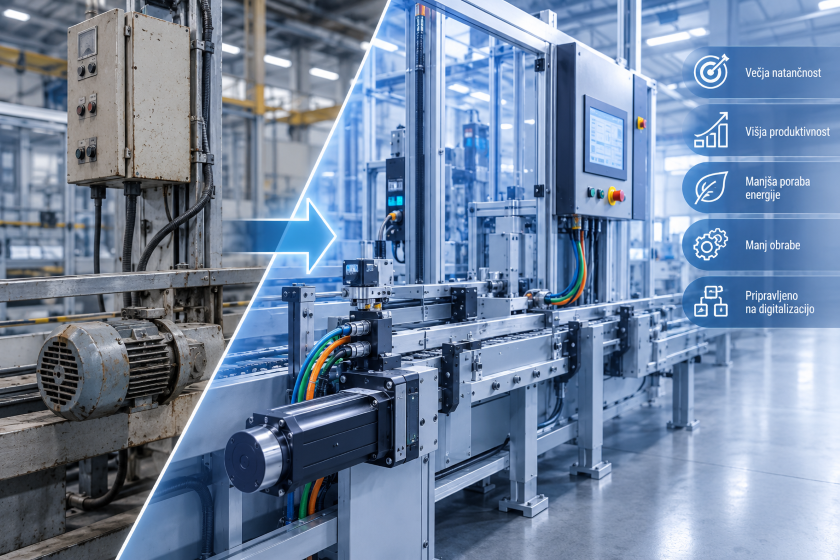
What does the renovation involve?
Assessment of the Existing System:
Every modernization project begins with a detailed evaluation of the current production line.
- Identification of existing drives, motors, mechanical assemblies, and control systems.
- Assessment of component compatibility with modern digital servo technology.
- Development of a modernization strategy with minimal modifications to the existing equipment.
Selection and integration of new equipment:
Based on the analysis, the most suitable hardware is selected and integrated into the production line.
- Installation of servo motors with appropriate torque and feedback systems
- Integration of servo drives and motion controllers
- Connection to the existing PLC or upgrade with advanced control systems
Software configuration and commissioning:
Following the hardware installation, the system is configured, optimized, and commissioned.
- Servo axis parameterization (position, speed, and torque).
- Synchronization with existing conveyors, sensors, and HMI systems.
- Functional testing, performance optimization, and operator training.
Key Benefits of Production Line Modernization
Modernizing an existing production line offers numerous technical and economic advantages, including:
- Precise positioning of workpieces, tools, and machine mechanisms.
- Dynamic synchronization of multiple axes without mechanical linkages.
- Faster production cycles and reduced downtime. Lower mechanical wear through smoother acceleration, deceleration, and motion control.
- Greater software flexibility for different products and manufacturing processes.
Why Modernize Instead of Purchasing a New Production Line?
In many cases, modernization is a far more cost-effective investment than purchasing new equipment. While the mechanical structure of industrial machinery often remains reliable for decades, electrical components and automation systems become obsolete much sooner. Replacing drives, controllers, and software can deliver performance comparable to that of a new production line at a fraction of the investment.
The benefits of modernization include:
- Lower investment costs compared to purchasing a new production line.
- Shorter implementation time and reduced production downtime.
- Preservation of the existing mechanical infrastructure.
- Minimal modifications to the production area and existing installations.
- Improved energy efficiency.
- Increased reliability and long-term availability of spare parts.
- Digital integration with higher-level systems such as SCADA, MES, and ERP.
- A future-ready production line prepared for further automation and digitalization.
Comprehensive Modernization Services
We provide complete production line modernization services, from the initial assessment and project planning to equipment supply, programming, commissioning, and after-sales support.
By implementing advanced servo technology, we help manufacturers increase productivity, improve product quality, enhance machine performance, and significantly extend the service life of existing production lines—all at substantially lower costs than investing in entirely new equipment.