CNC Machine Automation: When Does It Pay Off and How to Get Started?
CNC machine automation is becoming one of the key solutions for manufacturers looking to increase productivity, make better use of existing equipment, and reduce dependence on manual machine loading and unloading. In modern manufacturing, it is no longer enough for a machine to be accurate and powerful — what also matters is how much time it actually spends producing parts.
In many companies, CNC machines remain idle for significant periods due to setup, workpiece changes, adjustments, waiting for an operator, or organizational delays. This is where automation can make the greatest difference. By introducing automatic workpiece loading and unloading, standardized workholding, and digital production control, manufacturers can significantly increase machine utilization without necessarily investing in additional machining centres.
Automation Is Not Just for Large Production Batches
CNC automation is often associated with high-volume production. In practice, however, modern modular systems also make automation suitable for small batches, recurring orders, and production environments with a wide variety of workpieces.
One of the main advantages of automation is the ability to keep machines running for longer periods without the constant presence of an operator. Machines can continue producing during breaks, afternoon shifts, overnight, or at weekends. This allows companies to gain additional production capacity from equipment they already own.
However, a robot alone does not make a complete automation solution. Reliable automation requires the workholding system, pallets, workpieces, robot, measuring processes, and production management software to work together as one integrated system.
Why Is Standardized Workholding the Foundation of Automation?
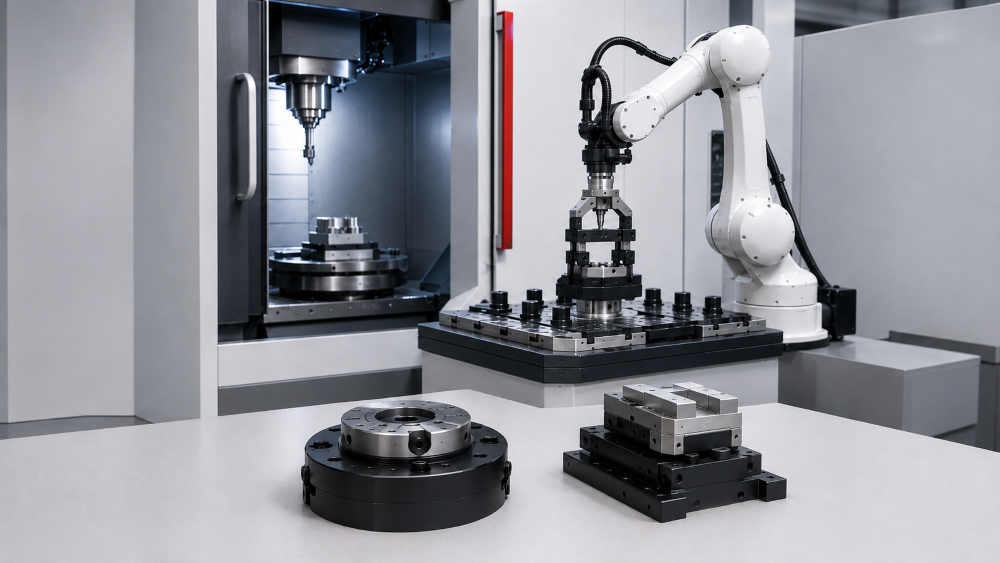
Successful CNC automation starts with workholding. Before a robot can safely pick up a workpiece and load it into a machine, the workpiece must always be clamped in a consistent, repeatable, and clearly defined position.
Zero-point workholding systems allow workpieces to be prepared outside the machine and then loaded quickly with high repeatability. This reduces setup times, minimizes the risk of errors, and ensures that the workpiece position remains accurately defined throughout the entire process — from the first machining operation to final measurement.
EROWA therefore approaches automation as a complete manufacturing concept. The robot is an important part of the system, but it can only operate efficiently when a standardized and reliable interface exists between the workpiece, pallet, and machine.
Which CNC Machines Can Be Automated?
Automation is not limited to new machines or equipment from a specific manufacturer. In many cases, existing CNC machines can also be automated, provided they offer suitable accessibility, an appropriate workholding concept, and the technical interfaces required to connect them to an automation system.
Automation is commonly used with:
- 3-axis milling machines
- 5-axis machining centres
- Vertical and horizontal machining centres
- Mill-turn centres
- die-sinking EDM and wire-cut EDM
- Grinding machines
- Measuring and presetting stations
When planning an automation project, several factors need to be considered. These include the type of workpieces, pallet dimensions and weight, machining times, number of workpiece changes, available floor space, and the overall objective of the automation project.
In some applications, automating a single machine is the most effective solution. In others, one robot can serve several machines simultaneously.
From Manual Operation to a Smart Manufacturing Cell
One of the key advantages of EROWA solutions is their modularity. A company can start with standardized workholding and later add automated handling, measuring systems, pallet identification, and production management software.
This step-by-step approach allows automation to grow according to actual production requirements. There is no need to invest in a fully automated manufacturing cell from the beginning. What matters is choosing a system that can be expanded as future requirements change.
As production needs grow, the automation system can develop into a complete manufacturing solution connecting machines, robots, workholding systems, measuring equipment, and digital order management. This enables manufacturers to move gradually from individual improvements towards a more connected, efficient, and predictable production environment.
What Does Modern CNC Automation Include?
Modern CNC machine automation can combine several interconnected elements:
- Automatic loading and unloading of workpieces
- Standardized pallets and workholding systems
- Zero-point clamping for repeatable positioning
- Robotic handling of one or multiple machines
- Pallet and workpiece identification
- Measurement and presetting outside the machine
- Digital management of production orders and processes
- Unattended or partially unattended production
This approach provides greater control over the entire manufacturing process. Workpieces, pallets, tools, and production orders are clearly organized, making production more predictable and repeatable.
When Does CNC Automation Pay Off?
The decision to automate should not be based solely on production batch size. In many cases, a more important question is how much productive time is lost each day due to setup, manual loading and unloading, waiting for operators, or organizational interruptions.
Automation is particularly worth considering when:
- Machines frequently remain idle during workpiece changes
- Operators spend significant time manually loading and unloading machines
- Night and weekend production capacity is not being utilized
- Orders are repeated but require frequent new setups
- Skilled operators are difficult to recruit or allocate
- Demand exceeds existing production capacity
In these situations, the main benefit of automation does not necessarily come from faster machining. Instead, it comes from increasing the number of productive machine hours. Machines can operate for longer periods, more consistently, and with fewer interruptions.
More Than a Robot: A Complete Manufacturing System
CNC machine automation does not begin and end with a robot. A robot can reduce the amount of manual machine tending, but the greatest benefits are achieved when all key elements are connected: workholding, workpieces, machines, measurement, production organization, and process control.
EROWA solutions are based on this integrated approach. Standardized workholding ensures repeatability, robotic handling increases machine availability, measuring processes help maintain quality, and process control software improves production planning and organization.
The result is a manufacturing process that is more reliable, transparent, and better prepared for changing production requirements.
Conclusion
CNC machine automation is a practical solution for manufacturers looking to increase the utilization of existing machines, reduce downtime, and create a more stable production process. It is not reserved for large production batches and can be equally effective for small batches and frequently changing orders.
The key to successful automation is an integrated approach. The first step is to establish repeatable workholding and a well-organized production process. Automation can then be expanded according to actual production requirements.
With EROWA systems, manufacturers can introduce automation gradually — from standardized workholding and robotic machine tending to a fully connected smart manufacturing cell.