From the TNC 110 to the TNC7 – five decades of CNC control development
In 2026, HEIDENHAIN celebrates 50 years of TNC controls. Over five decades, TNC controls have evolved from early systems for simple programming directly at the machine to modern CNC controls for complex multi-axis and combined machining operations.
During this time, HEIDENHAIN has developed several generations of controls that have evolved alongside machine tools, manufacturing technologies and user requirements. Despite major technological advances, the core philosophy has remained the same: to make programming and operating a CNC machine as intuitive as possible for the operator.
The beginnings of TNC controls
HEIDENHAIN’s development of its own CNC controls dates back to the early 1970s. An important milestone followed in 1976 with the introduction of the TNC 110.
The control enabled operators to enter machining positions directly at the machine and laid the foundation for the further development of the TNC family. The abbreviation TNC stands for Touch Numerical Control.
From the very beginning, the focus was on practical operation directly at the machine – a concept that has remained important throughout all subsequent generations.
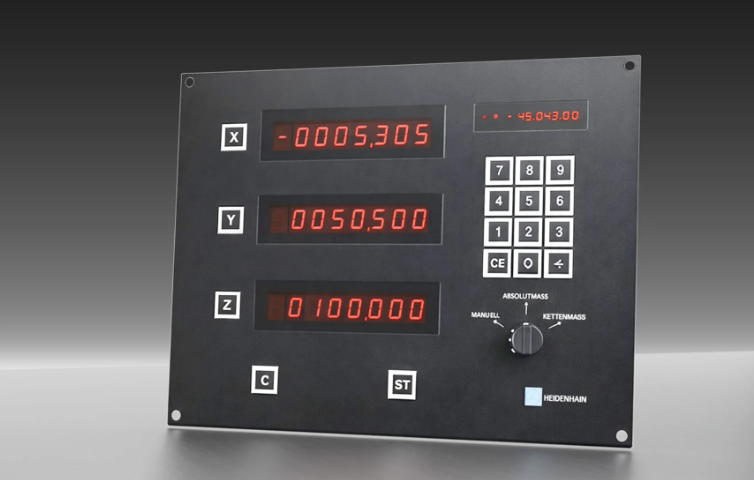
Key milestones in the history of TNC controls
1976 – TNC 110
The first TNC 110 control is introduced. It does not yet have program memory, and a manual of just ten pages is sufficient for setup and operation.
The TNC 110 enables operators to enter machining positions directly at the machine.
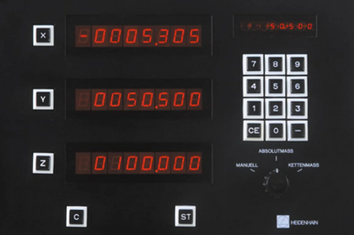
1977 – TNC 121
Just one year later, the TNC 121 follows, introducing program memory and the distinctive orange function keys that would become a recognizable feature of HEIDENHAIN controls.
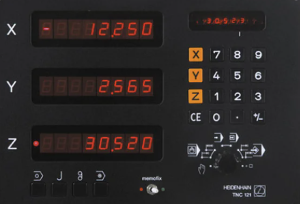
1979 – TNC 135
With the TNC 135, HEIDENHAIN introduces one of the most important features of its CNC controls: Klartext conversational programming.
An easy-to-understand dialogue guides the operator step by step through the individual stages of NC programming.
The TNC 135 is also the first TNC control with a screen and represents an important step towards even more intuitive CNC machine operation.
1981 – TNC 145
The TNC 145 is introduced as the first TNC contouring control. Thanks to Klartext conversational programming, users can program more complex contours directly at the machine.
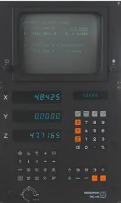
1984 – TNC 155
The TNC 155 introduces graphical simulation during machining and support for ISO programming.
This also makes TNC controls suitable for use in vocational and technical training.
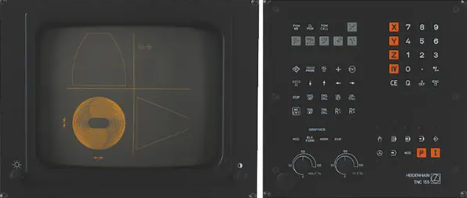
1987 – TNC 355
With the TNC 355, HEIDENHAIN separates the operating keyboard from the control logic unit.
This new design proves successful and has a significant influence on the further development of TNC controls.
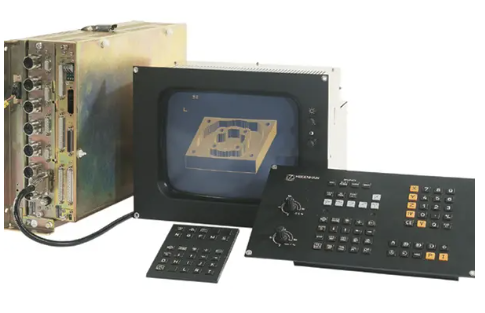
1994 – TNC 426
The TNC 426 integrates speed and current controllers as well as comprehensive motion control functions.
HEIDENHAIN thus offers a complete system consisting of the CNC control, drives and motors.
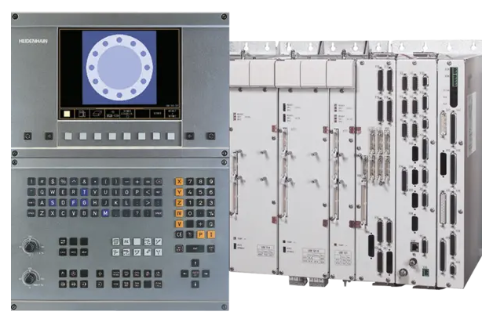
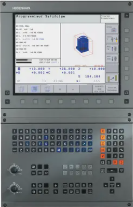
2001 – iTNC 530
In 2001, the iTNC 530 is introduced, with the “i” referring to its Intel processor architecture.
The control continues the long tradition of TNC contouring controls while significantly increasing computing power and data processing speed. For the first time, the main NC computer is separated from the control unit.
2011 – TNC 640
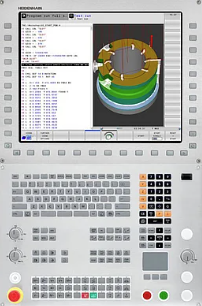
The TNC 640 is the first TNC control to combine milling and turning within the done-in-one machining concept.
It also introduces a new keyboard design, an elegant stainless-steel housing and a large 19-inch display.
2021 – TNC7
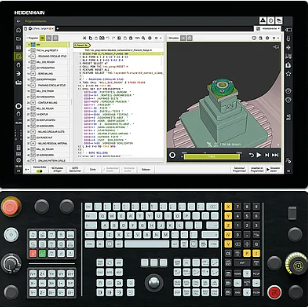
In 2021, HEIDENHAIN introduces the TNC7, a new generation of TNC controls.
The TNC7 combines proven Klartext functions with new possibilities, with graphical programming being one of the key highlights. Its development continues to focus on practical solutions for the operator’s daily work and intuitive CNC machine operation.
Klartext – programming directly at the machine
One of the most distinctive features of HEIDENHAIN controls is Klartext conversational programming.
It was first introduced in 1979 with the TNC 135, and its basic concept has remained largely unchanged ever since: to enable operators to create programs directly at the machine in a clear and understandable way.
The control guides the user through the individual programming steps and requests the information required for each machining operation.
Another important advantage of the TNC family is its high level of compatibility between generations. Long-term users can therefore retain much of their existing knowledge and many of their programs when moving to a newer control, while gaining access to new functions at the same time.
From simple positioning to complex machining
The development of TNC controls also reflects the evolution of CNC machine tools themselves.
Early controls were primarily intended for simple positioning and basic machining tasks. Today’s systems enable coordinated control of multiple axes, complex five-axis machining, the combination of different machining technologies, and the integration of measurement and automation directly into the production process.
The CNC control is therefore no longer simply a system for executing an NC program. It has become a central element of the entire machining process.
Knowledge as part of TNC development
For decades, the development of new control functions has been accompanied by training for users, service technicians and machine tool builders.
Today, training ranges from the fundamentals of Klartext programming to five-axis machining, workpiece and tool measurement, PLC programming, machine optimization, and diagnostics and service of CNC controls and measuring systems.
In addition to developing the technology itself, HEIDENHAIN therefore places strong emphasis on transferring knowledge to users.
50 years of development – and the story continues
From the first TNC 110 to today’s TNC7, CNC control technology has changed fundamentally. Machine performance, the number of controlled axes, machining complexity and production connectivity are now at a completely different level than they were five decades ago.
Yet HEIDENHAIN’s fundamental philosophy remains unchanged: a powerful CNC control should make programming, operation and everyday work at the machine easier for the operator.
This combination of advanced technology and intuitive operation is one of the reasons why HEIDENHAIN TNC controls have played an important role in CNC machining for five decades.
HEIDENHAIN and Trecon
Trecon has been working with HEIDENHAIN since 1998. We provide customers with support in selecting and using CNC controls, servicing components, modernizing and retrofitting machine tools, and providing training for HEIDENHAIN controls.
We combine our knowledge of CNC controls with expertise in drive technology, measuring systems and machine mechanics, enabling us to take a comprehensive approach to the modernization, diagnostics and servicing of CNC machine tools.